
Consumer Equilibrium- Definition, Examples & Real-Life Applications
Consumer Equilibrium - Definition, Examples & Real-Life Applications
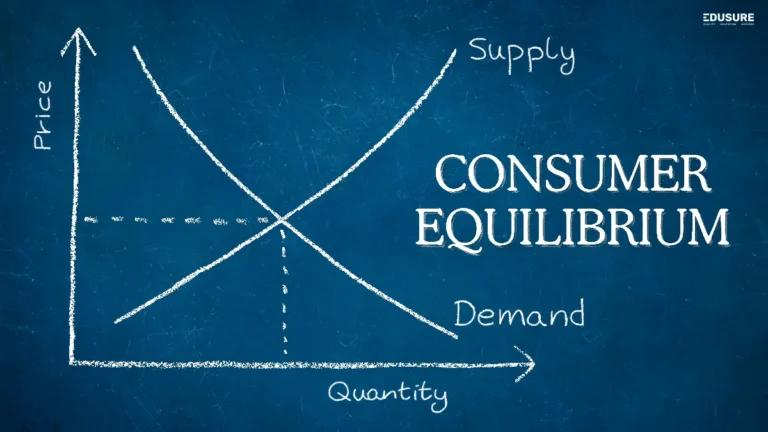
Consumer equilibrium is the point at which a consumer maximises total satisfaction (utility) within a limited income. At this point, the marginal utility per unit of currency is equal across all goods or services consumed. In this article, we’ll break down the definition, explore the utility maximisation formula, explain key assumptions, and apply the concept using real-life examples from student life and streaming services.
What is Consumer Equilibrium?
Consumer equilibrium refers to a situation in microeconomics.
It is a situation where a consumer achieves the highest level of satisfaction or utility (satisfaction or well-being) from the goods and services they choose to consume, given their budget constraint and the prices of those goods and services.
In other words, it represents the point at which consumers maximise their overall satisfaction or utility while staying within their budget at the same time.
The balance can be obtained from the combination of two goods, which are within reach of the consumer’s financial budget. In this way, the possibility of a higher level of satisfaction can be achieved where the indifference curve is higher.
One way to obtain the balance of the consumer is through the knowledge of what the consumer likes and his economic limitations. This will depend on the income that he has and the prices that the market understands.
Despite this, some balance changes may arise due to the following:
Price Increase
Through consumer theory, various alternatives are presented on how a consumer’s behaviour could be when a series of variations in price, income, tastes, and preferences are presented.
Income Effectiveness, Tastes, and Preferences
All these elements induce the consumer to make the right decisions about acquiring or purchasing goods and represent their behaviour.
Consumer equilibrium can be achieved when:
- The consumer is satisfied with the goods and services purchased, despite the limitations of income and prices.
- The equilibrium a consumer reaches is due to the products related to the number of goods and services they buy, thanks to their current income level.
This type of balance allows consumers to benefit from their purchases, even knowing the potential of the products consumed by the competition.
The Consumer Equilibrium Graph
The consumer’s equilibrium can be represented graphically as a point of tangency where the indifference curve and the economic constraint meet.
Therefore, this equilibrium is obtained when the slope of the indifference curve and the slope of the consumer’s budget line have the same level of equality
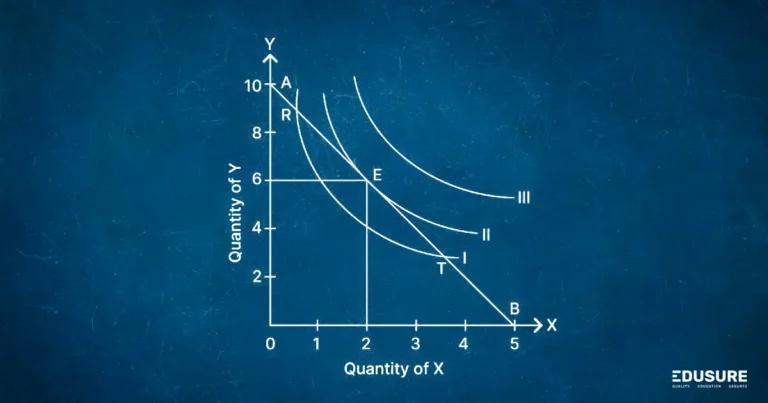
The provided graph illustrates consumer equilibrium, where:
AB – Budget line
I, II, and III – Indifference curves. They are a portion of an individual’s indifference map.
Given the limited income sources, a consumer cannot attain a position beyond the budget line. R, E represent infinite numbers of attainable bundles on AB, and T.
These and the points on the budget line AB are attainable with the limited income of the consumer.
The Consumer Equilibrium Formula
Consumer equilibrium is a part of the consumer theory of economics.
Within consumer theory, utility refers to the ability to satisfy the needs of a consumer. Knowing that goods and services are valued differently by each individual, academics have created a formula to measure consumer equilibrium, which is:
MUx ÷ Px = MUy ÷ Py
Where,
- MUx: The marginal utility derived from a particular good, identified here by the letter x. MUx represents a consumer’s additional satisfaction if he purchases one more unit.
- Px: The price of the goods identified by the letter x.
- MUy: The marginal utility derived from another good is y. It also represents a consumer’s extra satisfaction from having one more unit.
- Py: The price of the goods identified by the letter y.
The marginal utility can be Positive, Negative, or Zero. Let’s see what each result means.
Choosing Your Subscriptions Wisely Ravi has ₹500 to spend each month. He wants to subscribe to Netflix (₹200), Spotify (₹150), and Hotstar (₹250). He rates the utility he gets as: Netflix = 60 utils Spotify = 45 utils Hotstar = 50 utils
Netflix: 60/200 = 0.3 Spotify: 45/150 = 0.3 Hotstar: 50/250 = 0.2 Ravi should pick Netflix + Spotify since they give equal highest utility per rupee. This is consumer equilibrium—where MU/Price is equal for the goods he chooses. |
Positive Marginal Utility
Positive marginal utility occurs when obtaining more than one item brings additional satisfaction to the consumer.
Suppose you like to eat a slice of chocolate cake, but a second slice would bring you extra joy. So your marginal utility from consuming pie is positive.
For Example:
Ankit goes to the market and buys two kilos of fruit. Knowing some guests will visit him that day. He buys two more kilos of fruit. The marginal utility is positive since he does not need to return to the market for a new purchase, and his budget covers the additional items.
Negative Marginal Utility
Negative marginal utility occurs when consuming too much of an item can cause you harm. For example, eating two whole lemon tarts can make you sick.
For Example:
Ritika has diabetes and can eat a limited amount of sweets each day. If she buys more than one chocolate bar at the market and consumes it, she may be sick. In this case, the additional elements do not bring more satisfaction but rather a risk or problem. In this case, marginal utility is negative.
Zero Marginal Utility
Zero marginal utility happens when consuming more than one item does not bring additional satisfaction.
For example, you may feel quite full after two pizza slices and crave it even after having a third slice. In such a scenario, your marginal utility from eating pizza is zero.
What is the Consumer’s Break-Even Point?
The consumer’s break-even point occurs when they find the most significant possible utility and satisfaction in a commodity, given their income or budget. The consumer must spend his limited budget on the goods that give him the highest marginal utility per dollar.
As you may have already inferred, the consumer’s break-even point will depend on the individual’s budget constraint and the price of the products/services. Therefore, when the ratio MU ÷ P is the same for all goods, the consumer maximises his total utility.
Consumer theory believes that there is a tendency for all goods and services to reach a zero marginal unit. When this happens, the consumer no longer needs the product and ends consumption.
Behavioral Economics: When Consumers Don’t Behave Rationally
In real life, consumers don’t always act rationally. We often rely on shortcuts, emotions, or habits. This is called bounded rationality—we look for “good enough” choices instead of the perfect one.
Common behavioural biases that affect equilibrium:
-
Status quo bias: We stick to old choices even if they offer lower utility.
-
Choice overload: Too many options confuse us.
-
Anchoring: First prices or experiences influence later decisions.
-
Mental accounting: We treat money in different categories, even when it’s the same.
Why Ravi Keeps His Old Prime Video Plan Even though switching to Netflix would give Ravi more value for money, he sticks with Prime Video because he’s used to it. This is status quo bias, and it keeps him from reaching consumer equilibrium. |
The Bottom Line
Every consumer makes efforts to attain maximum satisfaction from the commodity he/she invests in.
This satisfaction derives from benefits arising from the consumption of the product.
aAfter achieving consumer equilibrium, he will be in no state of further change. The level of satisfaction will only go down after this stage.
EduSure has developed the best and most structured programme to help students crack the Masters in Economics Entrance Exams. With a legacy spanning 14 years, EduSure boasts consistent top rankings in prestigious institutions like DSE, JNU, IGIDR, and IIT.
Student Testimonials and Success Stories:
Discover the success stories of EduSure students by visiting our YouTube channel: YouTube. Hear firsthand experiences from students who have achieved their dreams with our guidance.
Speak to an EduSure Student Counsellor:
For personalised advice and to speak to an EduSure student counsellor, call us at 8100824600/01. Our counsellors are here to help you every step of the way.
Faculty Spotlight
Samkith Banthia: ISI Alumnus, Eco(H) St. Xavier's Kolkata, FRM from GARP, Formerly with Barclays Bank.
Samkith Sir transitioned from a successful banking career to teaching and mentoring aspiring students. With his expertise in mathematics and a nurturing demeanour, he is dedicated to guiding students toward academic excellence.
Mahima Banthia: DSE Alumnus, Eco(H) SRCC Delhi, Former Lecturer at St. Stephen’s College Delhi, UGC NET qualified.
In Mahima Ma’am’s class, we prioritise logical reasoning and emphasise conceptual understanding, ensuring mastery of macroeconomics. Mahima Ma’am also handles administrative responsibilities at EduSure, ensuring the highest quality service to every student.
Join the EduSure Program:
To enrol in our courses, drop in your details at EduSure Form, and we'll get back to you as soon as we can.
Email us: