
CU Economics: Syllabus, Exam Pattern, Best Resources & Expert Guidance!
CU Economics: Syllabus, Exam Pattern, Best Resources & Expert Guidance!
At the University of Calcutta, you're not just learning about economics; you're gaining the tools to shape the world.
With a rich legacy spanning over 160 years, CU is known for academic excellence and producing leaders who drive change.
The Economics program at CU offers more than theory. It prepares you to solve real-world problems, tackle economic challenges, and carve out your career in a competitive global market.
However, navigating through the complexities of the CU curriculum—especially in Semester 2 and Semester 4—can be overwhelming.
That’s why in this article, we are going to talk about everything regardin CU Economics - syllabus, resources, exam patter, preparation strategy and much more.
So are you ready to succeed in your CU Economics journey?
Overview of CU Economics
We have compiled a well-researched overview of the CU Economics Course. Here's what it looks like:
Why Study Economics at Calcutta University?
Calcutta University (CU) is one of India’s oldest and most prestigious institutions. The economics program here is known for its rigorous curriculum, research opportunities, and career prospects.
Whether you aim to pursue higher studies, join the corporate world, or enter policymaking, CU Economics provides the foundation you need.
Here’s what makes CU Economics stand out:
Feature | Details |
Legacy & Reputation | Established in 1857, CU is among the top universities in India for economics. |
Strong Faculty | Learn from renowned economists and subject experts. |
Comprehensive Curriculum | Covers theory, quantitative methods, and applied economics. |
Industry-Relevant Skills | Emphasis on data analysis, research, and policy evaluation. |
Career Opportunities | Graduates work in academia, government, the private sector, and global organisations. |
Who is This Program For?
Economics at CU is designed for students who:
✅ Aspire for Diverse Careers: Aim for roles in research, policymaking, banking, corporate sectors, or international organisations.
✅ Aspire for Diverse Careers: Aim for roles in research, policymaking, banking, corporate sectors, or international organisations.
✅ Plan for Advanced Studies: Intend to pursue postgraduate studies like an M.A., M.Phil., or Ph.D. in Economics.
What to Expect from CU Economics?
- Structured Learning: The program is organised into semesters, each building upon the last, covering areas like microeconomics, macroeconomics, and econometrics.
- Practical Exposure: Opportunities for research projects, internships, and seminars enhance practical understanding.
- Quantitative Emphasis: A strong focus on quantitative methods, statistics, and data analysis equips students with essential analytical skills.
- Continuous Assessment: Regular evaluations, including internal exams and assignments, ensure consistent academic engagement.
Did You Know?CU Economics graduates have secured top positions in academia, government think tanks, and corporate firms like RBI, NITI Aayog, the World Bank, and investment banks. |
Admission Process for CU Economics
Admission to Calcutta University's economics program follows specific guidelines.
Whether you are applying for the B.A./B.Sc. (Honours) in Economics or the M.A. in Economics, understanding the eligibility criteria, application process, seat reservation policies, and selection procedure is important.
CU Economics Eligibility Criteria
The very first thing that you should know about is whether you are eligible or not.
Only if you are eligible for getting into CU’s economics program, then only you can proceed with other things.
For B.A./B.Sc. (Honours) in Economics
- General Category: Must have passed Class 12 (10+2) with at least 60% marks in Economics and Mathematics.
- Reserved Categories (SC/ST/OBC/PWD): Relaxation in marks is provided as per CU regulations.
- Foreign Students: Admission is handled through CU’s International Admissions Department.
For M.A. in Economics
- Must have a bachelor’s degree in economics (honours) from CU or any recognised university.
- Selection is merit-based for CU graduates and exam-based for external candidates.
- Reservation norms apply for SC/ST/OBC/PWD candidates.
CU Economics Application Process (Detailed Guide)
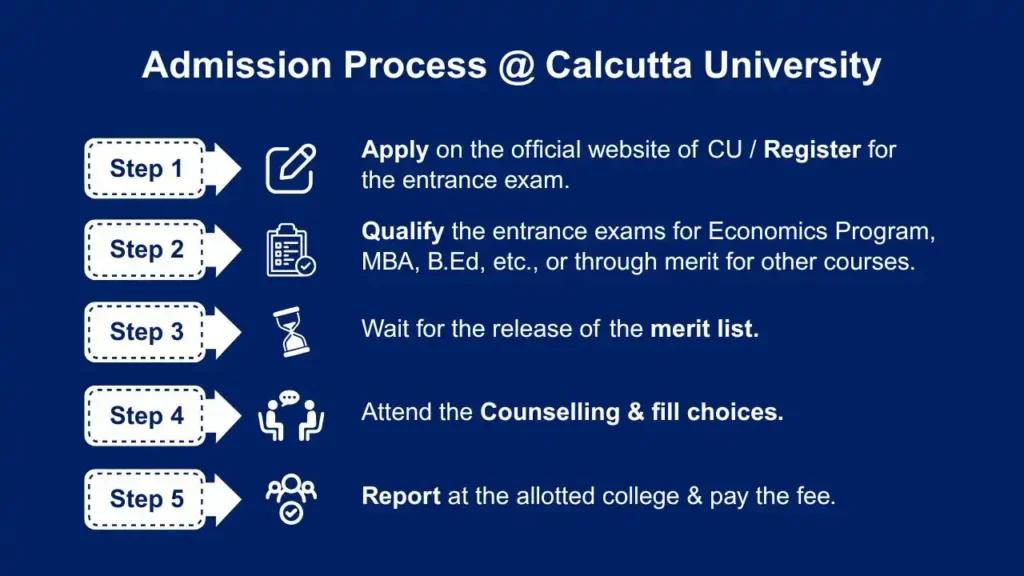
If you are eligible for CU Economics, then what you should know is - The Application Process. We have provided a very brief overview of the application process just to get you started.
Once you start your application process, you are guided through each and every step.
Step 1: Visit the Official CU Admissions Portal
The application process is conducted online through CU's official website.
Before applying, make sure that you meet the eligibility criteria for your selected program.
Step 2: Register & Fill Out the Online Application Form
1️⃣ Create an Account
- Click on the ‘Apply Now’ button on the admissions portal.
- Enter your name, date of birth, email ID, and mobile number.
- Create a password and verify your email via OTP.
2️⃣ Select Your Course & Category
- Choose a B.A./B.Sc. (Hons.) in Economics or an M.A. in Economics.
- If applicable, select your reservation category (SC/ST/OBC/PWD).
- CU students applying for M.A. admission via merit list should select the "Direct Admission" option.
3️⃣ Enter Academic Details
- For B.A./B.Sc. Applicants:
- Class 10 & Class 12 details (Board, Year, Roll No.).
- Marks obtained in economics, mathematics, and other subjects.
- For M.A. Applicants:
- Bachelor's degree details (university, year of passing, marks).
- Final-year students must upload a Provisional Certificate.
4️⃣ Upload Required Documents
- Recent passport-sized photograph (3.5 cm x 3.5 cm, max 15 KB).
- Scanned signature (max 15 KB).
- Class 12/Bachelor’s degree mark sheets.
- Caste/Disability Certificate (if applicable).
📌 Tip: Make sure that all of your documents are in JPEG/PDF format and clearly visible.
Step 3: Pay the Application Fee
Category | Application Fee |
General & OBC | ₹100 |
SC/ST/PWD | ₹50 |
- Payment can be made via debit card**, credit card, net banking, or UPI**.
- After successful payment, download the transaction receipt.
📌 Important: The application fee is non-refundable.
Step 4: Submit the Online Application & Download Receipt
- Once all details are entered, review your form for any errors.
- Click ‘Final Submit’ (you cannot edit after submission).
- Download & print the completed application form and payment receipt.
- Your application number will be generated—note it down for future reference.
Step 5: Offline Submission of Documents (Mandatory for Verification)
- **Where to Submit?**The printed copy of the application form must be submitted at: Secretary Office (CU Home Science Campus), 20B Judges Court Road, Alipore, Kolkata – 700027 🕘 Submission Timings: Monday to Friday, 11 AM–2 PM & 3 PM–4 PM
- What to Submit? ✅ Printed application form (signed by the applicant) ✅ Class 10 & 12 mark sheets (self-attested copies) ✅ Bachelor’s degree mark sheet (for M.A. applicants) ✅ Caste Certificate (if applicable) ✅ Physically Challenged (PC) Certificate (if applicable) ✅ Original & photocopy of payment receipt
📌 Important Notes:
- Original documents must be shown during verification.
- If applying for multiple courses, mention your preference order clearly.
- Applications sent via post/courier must arrive before the deadline.
CU Economics Syllabus: Semester-Wise Breakdown
The Calcutta University Economics syllabus is designed to provide a strong conceptual foundation.
The Calcutta University Economics syllabus follows the Choice-Based Credit System (CBCS) and has been officially approved under the Common Curriculum Framework (CCF).
This system is designed to offer a balanced mix of foundational knowledge, applied skills, and research-orientated learning.
What is CBCS & How Does it Work?The Choice-Based Credit System (CBCS) is a flexible learning approach adopted by Calcutta University that allows students to choose courses based on their interests and career goals. It follows a credit-based evaluation rather than a fixed marks-based system. Key Features of CBCS
How Does CBCS Work?
|
The updated syllabus for Semesters 1 to 6, covering both the 4-year Honours & Honours with Research and the 3-year MDC (Major Discipline Course), is given below:
CU Semester 1 Syllabus
Paper | Course | Name of the Paper | Credit |
DSCC1 | ECOM | Microeconomics (I) | 3+1 |
SEC1 | ECOM | Introductory Statistics & Application (I) | 3+1 |
MN1 | MECO | Microeconomics (I) | 3+1 |
CC1/CC2 | MECO-MDC-CC | Microeconomics (I) | 3+1 |
SEC1 | MECO-SEC | Economic Data Analysis and Report Writing | 3+1 |
SEC1 | MECO-SEC | Entrepreneurship and Development | 3+1 |
IDC1 | ECOD | Elementary Economics | 2+1 |
CU Semester 2 Syllabus
Paper | Course | Name of the Paper | Credit |
DSCC2 | ECOM | Macroeconomics (I) | 3+1 |
SEC2 | ECOM | Introductory Statistics & Application (II) | 1+3 |
MN2 | MECO | Macroeconomics (I) | 3+1 |
CC1/CC2 | MECO-MDC-CC | Macroeconomics (I) | 3+1 |
SEC2 | MECO-SEC | Economic Data Analysis and Report Writing | 3+1 |
SEC2 | MECO-SEC | Entrepreneurship and Development | 3+1 |
IDC2 | ECOD | Elementary Economics | 2+1 |
CU Semester 3 Syllabus
Paper | Course | Name of the Paper | Credit |
DSCC3 | ECOM | Microeconomics (II) | 3+1 |
DSCC4 | ECOM | Development Economics (I) | 3+1 |
SEC3 | ECOM | Data Analysis and Research Methodology | 2+2 |
MN3 | MECO | Microeconomics (I) | 3+1 |
CC1/CC2 | MECO-MDC-CC | Development Economics (I) | 3+1 |
MDC_m1 | MECO-MDC-Minor | Microeconomics (I) | 3+1 |
SEC3 | MECO-SEC | Economic Data Analysis and Report Writing | 3+1 |
SEC3 | MECO-SEC | Entrepreneurship and Development | 3+1 |
IDC3 | ECOD | Elementary Economics | 2+1 |
CU Semester 4 Syllabus
Paper | Course | Name of the Paper | Credit |
DSCC5 | ECOM | Mathematical Economics (I) | 3+1 |
DSCC6 | ECOM | Macroeconomics (II) | 3+1 |
DSCC7 | ECOM | Statistics for Economics | 3+1 |
DSCC8 | ECOM | Indian Economics (I) | 3+1 |
MN4 | MECO | Macroeconomics (I) | 3+1 |
CC1/CC2 | MECO-MDC-CC | Indian Economics (I) | 3+1 |
CC1/CC2 | MECO-MDC-CC | Sustainable Development | 3+1 |
MDC_m2 | MECO-MDC-Minor | Macroeconomics (I) | 3+1 |
CU Semester 5 Syllabus
Paper | Course | Name of the Paper | Credit |
DSCC9 | ECOM | Microeconomics (III) | 3+1 |
DSCC10 | ECOM | Macroeconomics (III) | 3+1 |
DSCC11 | ECOM | Mathematical Economics (II) | 3+1 |
DSCC12 | ECOM | Econometrics (I) | 3+1 |
MN5 | MECO | Development Economics (I) | 3+1 |
CC1/CC2 | MECO-MDC-CC | Economic History of India (1857-1947) | 3+1 |
CC1 | MECO-MDC-CC | Public Finance | 3+1 |
MDC_m3 | MECO-MDC-Minor | Development Economics (I) | 3+1 |
MDC_m4 | MECO-MDC-Minor | Indian Economics (I) | 3+1 |
CU Semster 6 Syllabus
Paper | Course | Name of the Paper | Credit |
DSCC13 | ECOM | International Economics (I) | 3+1 |
DSCC14 | ECOM | Environmental & Resource Economics (I) | 3+1 |
DSCC15 | ECOM | Public Economics (I) | 3+1 |
Internship | ECOM | Summer Internship | 3 |
MN6 | MECO | Indian Economics (I) | 3+1 |
CC2 | MECO-MDC-CC | Public Finance | 3+1 |
CC1/CC2 | MECO-MDC-CC | Rural Development | 3+1 |
MDC_m5 | MECO-MDC-Minor | Sustainable Development | 3+1 |
MDC_m6 | MECO-MDC-Minor | Economic History of India (1857-1947) | 3+1 |
Career Opportunities After a CU Economics Degree
A degree in Economics from Calcutta University unlocks diverse career paths in finance, government, research, and corporate sectors.
Whether you plan to pursue higher studies, crack competitive exams, or enter the job market, this degree offers strong career prospects.
Higher Studies & Specialization
Many students choose higher studies to gain specialised knowledge and better job prospects.
Some popular postgraduate options include:
Degree | Scope & Benefits |
M.A./M.Sc. in Economics (ISI, DSE, JNU, IITs, CU) | Deepens theoretical and applied knowledge. Essential for research & academic careers. |
MBA in Finance/Analytics (IIMs, XLRI, FMS, IIFT) | Leads to careers in investment banking, consulting, and financial management. |
M.Phil./Ph.D. in Economics | Ideal for university teaching, economic research, and policy roles. |
Actuarial Science (IAI, IFoA, SOA) | Opens doors to high-paying risk assessment, insurance, and financial modelling roles. |
Data Science & Business Analytics | Combines economics with AI and big data for jobs in fintech, analytics, and market research. |
Government Jobs & Competitive Exams
Economics is highly relevant for prestigious government exams.
These roles offer job security, financial stability, and career growth.
Exam | Potential Career Roles |
UPSC (IAS, IES, RBI Grade B, SEBI, NABARD) | Indian Economic Service, Policy Analyst, Civil Services |
UGC NET / JRF | University Lecturer, Researcher |
IIT JAM / ISI / CUET PG | Entry to top PG Economics programs |
Banking & SSC Exams | RBI, SBI, IBPS, SEBI, SSC CGL |
Corporate Careers & Private Sector
Economics graduates are in high demand across various industries. Many find high-paying jobs in finance, consulting, and market research.
Industry | Job Roles | Top Recruiters |
Finance & Investment | Economist, Financial Analyst, Risk Manager | Goldman Sachs, JPMorgan, Citi |
Consulting & Research | Policy Analyst, Business Consultant | McKinsey, BCG, EY |
Data Science & Analytics | Data Scientist, Market Researcher | Google, Amazon, PwC |
Public Policy & NGOs | Research Associate, Economic Consultant | NITI Aayog, World Bank, UNDP |
4 Practical Tips to Ace CU Semesters
Many students find CU Economics challenging due to complex theories, numerically heavy topics, and vast syllabi.
The key to success is smart study techniques, structured learning, and strategic revision.
Follow these 4 practical tips to excel in your CU semesters, and see how EduSure can help you do it faster and better!
1. Build a Strong Conceptual Foundation
- Memorisation doesn’t work for Economics—you must understand the "why" behind concepts.
- Subjects like Microeconomics, Macroeconomics, and Econometrics require a step-by-step learning approach.
- Use the Feynman Technique: If you can teach it simply, you truly understand it.
- Break complex theories into smaller parts and relate them to real-world examples.
📌 How EduSure Helps: ✅ We teach from the absolute basics, ensuring that even students weak in math & stats can follow along. ✅ Real-life case studies & examples make concepts easy to understand & retain. ✅ Step-by-step learning structure so that no student feels left behind. |
.
2. Use Smart Memory Techniques to Retain More
- Mind Maps & Flowcharts – Helps visualise connections between concepts.
- Mnemonics & Acronyms – Create shortcodes for formulas & definitions (e.g., PRIME for Price Elasticity).
- **Active Recall—**Test yourself instead of just rereading.
- Pomodoro Technique – Study for 25-30 minutes, take a 5-minute break, and repeat.
📌 How EduSure Helps: ✅ We provide visually engaging notes with diagrams, tables, and flowcharts. ✅ Concept quizzes & flashcards help you test your understanding daily. ✅ Live doubt-clearing sessions that make sure that there is zero confusion in tricky topics. |
3. Master Numerical & Graph-Based Questions
- Subjects like Mathematical Economics, Statistics, and Econometrics require regular practice.
- Never memorise formulas blindly—always understand their derivation & logic.
- Solve past year papers (PYQs) to get familiar with exam question patterns.
- Draw graphs by hand to improve speed & accuracy.
📌 How EduSure Helps: ✅ We simplify difficult numericals using step-by-step problem-solving techniques. ✅ Regular mock tests simulate exam conditions & improve speed. ✅ Hand-drawn graph tutorials help students score full marks in application-based questions. |
4. Follow a Smart Time Management Strategy
- Study tough subjects when your brain is fresh (morning/evening).
- Keep a separate revision notebook for quick last-minute revision.
- Avoid last-minute cramming—space out your revisions for better retention.
Task | Ideal Time Allocation |
Concept Learning | 40% (Core theories, definitions) |
Numerical & Graph Practice | 30% (Math, Stats, Econometrics) |
Previous Year Questions (PYQs) | 20% (Exam conditioning) |
Revision & Short Notes | 10% (Summarizing key points) |
📌 How EduSure Helps: ✅ We provide a structured study plan so you never fall behind. ✅ Time-based mock tests improve speed & accuracy under pressure. ✅ Crash courses & revision sessions that make sure your last-minute prep is efficient & stress-free. |
The Bottom Line
Succeeding in CU Economics isn’t just about studying hard—it’s about studying smart. A strong conceptual foundation, effective memory techniques, and consistent numerical practice are essential for mastering the syllabus.
Managing time well and following a structured study plan can make all the difference. Instead of last-minute cramming, focus on understanding, application, and strategic revision.
With EduSure’s CU Sem 2 & 4 courses, you get expert guidance, structured learning, and in-depth practice to help you excel.
Whether it’s tackling tough numericals, breaking down theories, or refining exam strategies, we make sure that you’re always one step ahead.
Ready to boost your CU Economics preparation?
EduSure has developed the best and most structured programme to help students crack the Masters in Economics Entrance Exams. With a legacy spanning 14 years, EduSure boasts consistent top rankings in prestigious institutions like DSE, JNU, IGIDR, and IIT.
Student Testimonials and Success Stories:
Discover the success stories of EduSure students by visiting our YouTube channel: YouTube. Hear firsthand experiences from students who have achieved their dreams with our guidance.
Speak to an EduSure Student Counsellor:
For personalised advice and to speak to an EduSure student counsellor, call us at 8100824600/01. Our counsellors are here to help you every step of the way.
Faculty Spotlight
Samkith Banthia: ISI Alumnus, Eco(H) St. Xavier's Kolkata, FRM from GARP, Formerly with Barclays Bank.
Samkith Sir transitioned from a successful banking career to teaching and mentoring aspiring students. With his expertise in mathematics and a nurturing demeanor, he is dedicated to guiding students toward academic excellence.
Mahima Banthia: DSE Alumnus, Eco(H) SRCC Delhi, Former Lecturer at St. Stephen’s College Delhi, UGC NET qualified.
In Mahima Ma’am’s class, we prioritise logical reasoning and emphasise conceptual understanding, ensuring mastery of macroeconomics. Mahima Ma’am also handles administrative responsibilities at EduSure, ensuring the highest quality service to every student.
Join the EduSure Program:
To enrol in our courses, drop in your details here, and we'll get back to you as soon as we can.
Email us: