
GST 2.0 in India: New Tax Rates, Cheaper Cars, Electronics & FMCG
GST 2.0 in India: New Tax Rates, Cheaper Cars, Electronics & FMCG Explained
In September 2025 India launched GST 2.0, a major overhaul of the Goods & Services Tax aimed at reducing rates on many goods and services. The GST Council (chaired by FM Nirmala Sitharaman) approved these “next-gen” reforms on 3 September 2025, fulfilling PM Modi’s Independence Day promise of a “Diwali gift” in the form of lower taxes for common citizens. Under the new system, India’s GST has been simplified into two main slabs of 5% and 18%, plus a 40% rate on sin and luxury items. Effectively, the old 12% and 28% slabs were abolished. Official releases note that “GST reforms cut taxes on household essentials (soaps, toothpaste, Indian breads) to 5% or Nil”, and that staples like packaged foods will mostly come under the 5% rate. In short, GST 2.0 India (latest news for 2025) means a flatter, simpler tax structure with broad rate reductions for middle-class consumers.
Key Highlights of GST 2.0
-
Two-Slab Structure: GST now has just 5% and 18% main rates (plus 40% on sin/luxury goods) instead of four slabs. This simplifies compliance and aims to boost spending.
-
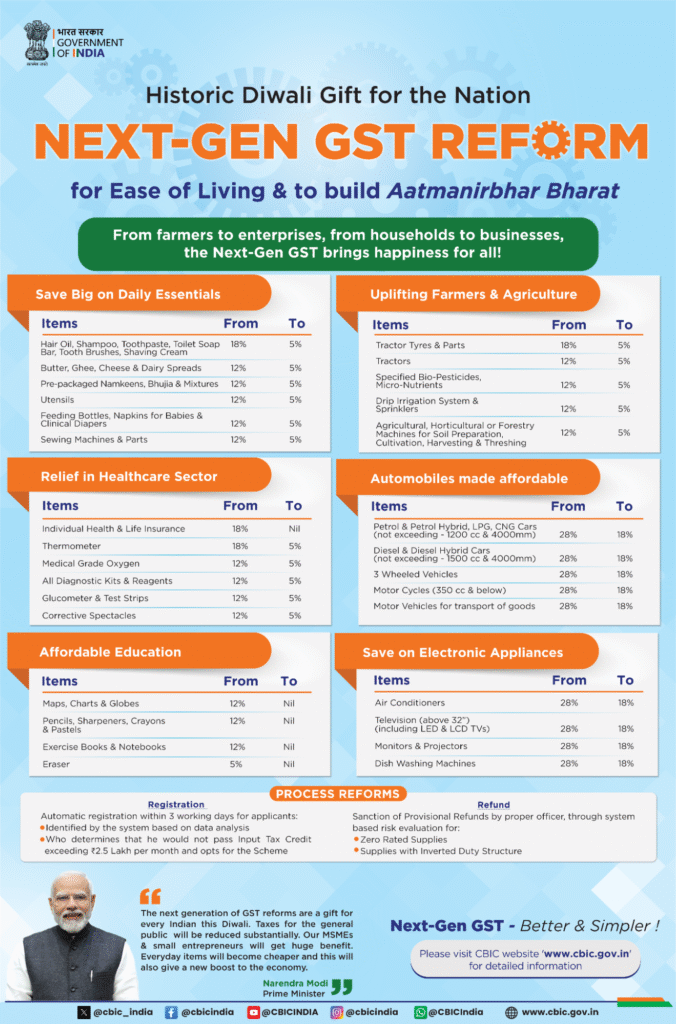
Essentials Cheaper: Everyday items like soap, toothpaste, cooking oil, Indian breads and other staples have been moved to 5% or zero GST. Packaged foods, medicines and dairy products largely fall to 5% (down from 12–18%)
-
Durables at 18%: Consumer electronics and appliances — e.g. TVs, refrigerators, air-conditioners, washing machines and dishwashers — now attract 18% GST instead of 28%. Small cars (petrol engines ≤1200cc, or sub-4m length) and two-wheelers have also dropped from 28% to 18%. Even ambulances, hybrid vehicles and luxury cars have lower effective taxes (see table below).
-
Green/EV Incentives: Electric vehicles continue at 5% GST, keeping them relatively cheaper to incentivize adoption (an increase had been recommended but was shelved).
-
Health & Insurance: Life and health insurance premiums are now fully exempt (0% GST). All drugs and medicines have a concessional 5% rate, and life-saving cancer/rare-disease drugs are entirely tax-exempt.
-
Agriculture & Rural: Farm equipment (irrigation systems, sprinklers, tractors, etc.) has been cut from 12% to 5%, lowering costs for farmers.
-
Sin & Luxury at 40%: To compensate, “sin” goods now face a higher unified rate of 40%. This includes tobacco products, pan masala and aerated drinks, as well as expensive cars (engine >1500cc) and luxury watches.
These changes came into effect on 22 September 2025 (the first day of Navratri), coinciding with the start of the festive season. The government estimates the tax cut will cost about ₹48,000 crore in revenue but expects it to spur consumption and offset the loss.
Learn Economics the Smarter Way
Old vs New GST Rates: Key Categories
To illustrate, the table below shows selected categories of goods and services with their GST rates before and after the September 2025 reforms:
| Category | Old GST Rate | New GST Rate |
|---|---|---|
| Daily necessities (soap, toothpaste, shampoo, etc.) | 18% | 5% |
| Packaged/processed foods (snacks, butter, ghee, jam, etc.) | 12–18% | 5% |
| TV, Refrigerator, AC, Washing Machine (durables) | 28% | 18% |
| Small petrol cars (≤1200cc or sub-4m) and two-wheelers | 28% | 18% |
| Electric vehicles (EVs) | 12% | 5% |
| Medicines (general) and healthcare products | 12% | 5% |
| Life & health insurance policies | 18% | 0% |
| Farm machinery & irrigation equipment | 12% | 5% |
| Tobacco, pan masala, aerated drinks | 28% | 40% |
| Super-luxury cars & items (>1,500cc or very expensive) | ~50% (with cess) | 40% |
Expert and Official Views
Economists and officials are closely watching how GST 2.0 plays out. Several experts note that the key will be pass-through – whether companies actually cut retail prices, and by how much. Aditi Nayar, Chief Economist at ICRA, says analysts will track “the extent of pass-through of lower GST to prices, how inventory management takes place and how firms cope with stranded taxes”. Gaura Sengupta (Chief Economist, IDFC First Bank) similarly points out that “FMCG companies will adjust prices in processed food where many of the reductions are concentrated” and that food inflation should be monitored closely.
On the official side, the Central Board of Indirect Taxes & Customs (CBIC) has issued FAQs clarifying implementation issues. For example, CBIC notes that e-way bills need not be cancelled for goods in transit – existing e-way bills stay valid during the transition. It also confirms that medicines carry a 5% rate, and all health/life insurance is zero-rated. These clarifications aim to smooth out technical glitches so traders and consumers can benefit without confusion.
From a macro perspective, many analysts welcome the potential boost to demand. Crisil notes that about 11 of India’s top 30 consumption items are directly affected by the rate cuts – covering roughly one-third of a typical household’s monthly spending. They expect this to “boost domestic consumption” just as global demand has turned uncertain. In the words of PM Modi’s “Bachat Utsav” messaging, lower taxes mean more spending power for the middle class during the festive season.
Economic Impact: Inflation, Fiscal Health and Spending
Inflation: Lower GST rates should put mild downward pressure on inflation, though the exact effect depends on how much of the tax cut is passed to consumers. Citi analysts estimate that full pass-through could shave about 1.1 percentage points off India’s CPI inflation. India’s retail inflation had already slowed to an 8-year low by July 2025. SBI’s chief economist Soumya Kanti Ghosh projects that, with the GST cuts, October 2025 inflation could fall to around 1.1% – potentially the lowest reading since 2004. (By comparison, a 2019 GST rate cut saw inflation dip about 0.35% in just a few months) In short, analysts now see room for continued easing of inflation, which even strengthens arguments for monetary policy easing by the RBI.
Fiscal and Revenue: The government expects a revenue hit of roughly ₹48,000–50,000 crore from the cut, as lower tax rates reduce GST collections. However, experts like S.K. Ghosh of SBI argue this loss may be offset by higher growth. He notes that the boost in consumption “will more than neutralise any possible revenue impact,” and that the effect on the fiscal deficit could be “almost insignificant or even positive”. In other words, by stimulating demand, GST 2.0 may preserve or even increase the tax base over time.
Consumer Spending: For consumers, the visible price cuts are the main effect. Shops reported long queues on rollout day as buyers rushed for discounted items. Reduced GST on vehicles, appliances and daily goods essentially leaves more money in pockets. This is especially timely ahead of Diwali, as manufacturers and retailers can offer lower-priced products. In the first five months of FY2026, average monthly GST collections were already up 10% year-on-year (₹2.01 lakh crore vs ₹1.83 lakh crore), suggesting buoyant consumer activity. If households respond by spending more on goods like electronics and FMCG, this would validate the policy’s goal of spurring domestic demand.
Why GST 2.0 Matters for Economics Aspirants
For MSc Economics and UGC-NET students, GST 2.0 is a must-know topic. It combines public finance, economic policy and current affairs – all key parts of the curriculum and competitive exams. Understanding this tax reform helps answer questions on fiscal policy, inflation, and growth outlook. In fact, exam questions often use real-world policy changes as case studies. Following GST 2.0 helps students see theory in action: how a government trade-off between short-term revenue and long-term growth plays out in data. Moreover, current affairs syllabi (Paper 1 of UGC-NET, for example) emphasize recent economic reforms, so being updated on GST rationalisation is directly relevant.
For exam prep, analyse GST 2.0 as you would any fiscal stimulus: identify winners (e.g. FMCG firms, auto buyers) and losers (e.g. luxury exporters, if any). Note how it ties into macro concepts like tax buoyancy and consumer surplus. This deepens conceptual understanding and also gives fresh content for answer-writing.
Prepare with Edusure (MSc/UGC-NET Economics Coaching)
Aspiring economists can strengthen their preparation by studying such current topics systematically. Edusure’s MSc Economics coaching offers in-depth coverage of public finance and recent policy reforms (including GST 2.0) tailored for entrance exams. The courses include expert lectures, current affairs modules and practice tests that ensure you can apply these concepts in exam questions. To boost your readiness, join Edusure’s specialized MSc Economics programs or book a free counselling call with Edusure mentors today. Professional guidance can help you integrate these updates into your study plan and maximize your scoring potential.
Book a free counselling session with Edusure Enroll Now – Limited Seats Available
EduSure has developed the best and most structured programme to help students crack the Masters in Economics Entrance Exams. With a legacy spanning 15 years, EduSure boasts consistent top rankings in prestigious institutions like DSE, JNU, IGIDR, and IIT.
Student Testimonials and Success Stories:
Discover the success stories of EduSure students by visiting our YouTube channel:YouTube. Hear firsthand experiences from students who have achieved their dreams with our guidance.
Speak to an EduSure Student Counsellor:
For personalised advice and to speak to an EduSure student counsellor, call us at 8100824600/01. Our counsellors are here to help you every step of the way.
Faculty Spotlight
Samkith Banthia: ISI Alumnus, Eco(H) St. Xavier's Kolkata, FRM from GARP, Formerly with Barclays Bank.
Samkith Sir transitioned from a successful banking career to teaching and mentoring aspiring students. With his expertise in mathematics and a nurturing demeanour, he is dedicated to guiding students toward academic excellence.
Mahima Banthia: DSE Alumnus, Eco(H) SRCC Delhi, Former Lecturer at St. Stephen’s College Delhi, UGC NET qualified.
In Mahima Ma’am’s class, we prioritise logical reasoning and emphasise conceptual understanding, ensuring mastery of macroeconomics. Mahima Ma’am also handles administrative responsibilities at EduSure, ensuring the highest quality service to every student.
Join the EduSure Program:
To enrol in our courses, drop in your details here, and we'll get back to you as soon as we can.
Email us: