Microeconomics vs Macroeconomics: Key Differences Explained
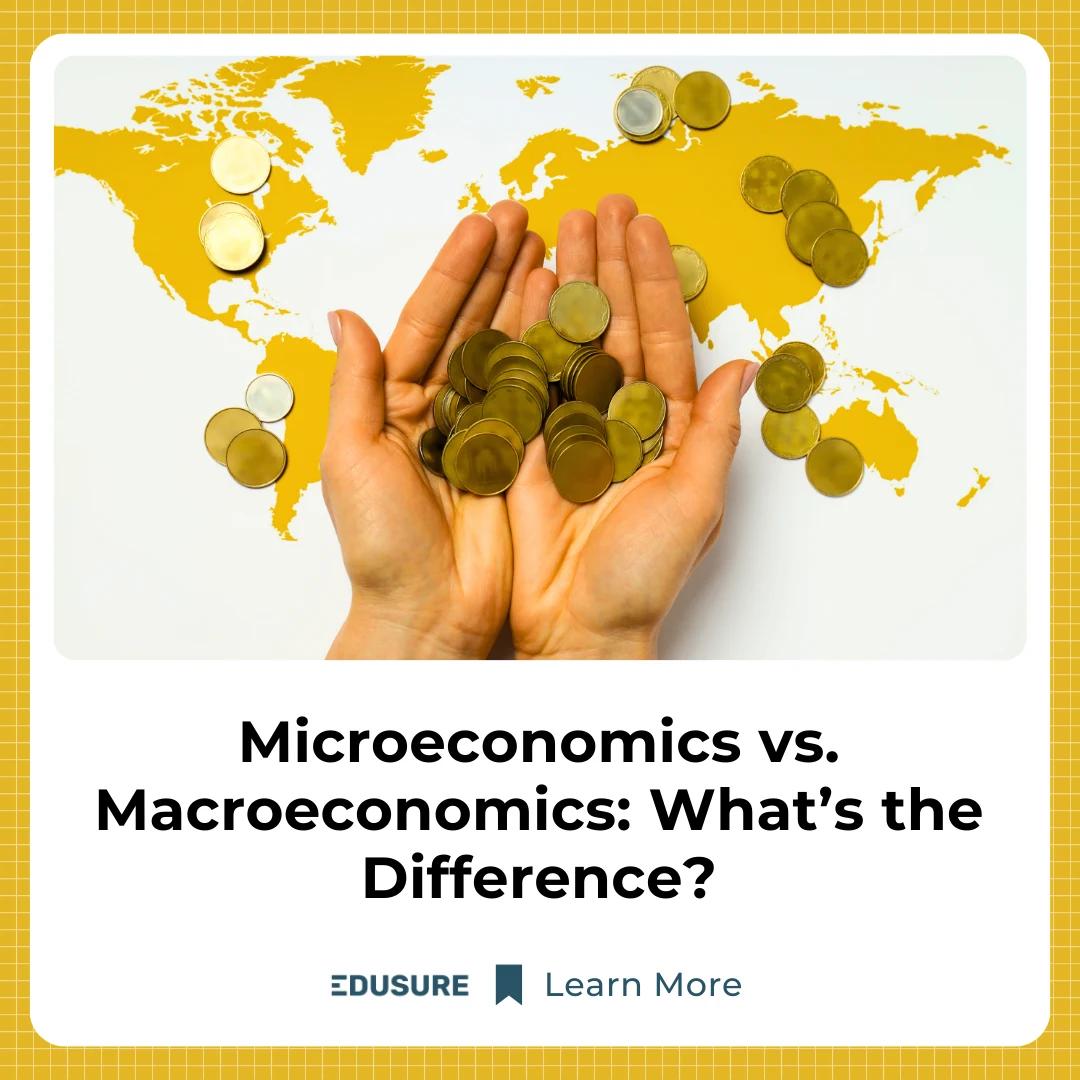
Microeconomics vs. Macroeconomics: What’s the Difference?
Economic is a study about how individuals, businesses and governments make choices on allocating resources to satisfy their needs. These groups determine how the resources are organised and coordinated to achieve maximum output. They are mostly concerned with the production, distribution and consumption of goods and services.
Economics is divided into two important sections, which are: Macroeconomics & Microeconomics.
In this article we will dive deep into what macroeconomics and microeconomics are and macroeconomics vs microeconomics.
What is Microeconomics?
Microeconomics is the study of decisions made by people and businesses regarding the allocation of resources and prices of goods and services. The government decides the regulation for taxes.
Microeconomics focuses on the supply that determines the price level of the economy.
It uses the bottom-up strategy to analyse the economy. In other words, microeconomics tries to understand human’s choices and allocation of resources.
It does not decide what are the changes taking place in the market, instead, it explains why there are changes happening in the market.
The key role of microeconomics is to examine how a company could maximise its production and capacity, so that it could lower the prices and compete in its industry. A lot of microeconomics information can be obtained from the financial statements.
The key factors of microeconomics are as follows:
- Demand, supply, and equilibrium
- Production theory
- Costs of production
- Labour economics
Examples: Individual demand, and price of a product.
What is Macroeconomics?
Macroeconomics is a branch of economics that depicts a substantial picture. It scrutinises itself with the economy at a massive scale, and several issues of an economy are considered.
The issues confronted by an economy and the headway that it makes are measured and apprehended as a part and parcel of macroeconomics.
Macroeconomics studies the association between various countries regarding how the policies of one nation have an upshot on the other.
It circumscribes within its scope, analysing the success and failure of the government strategies.
It focuses on aggregates and econometric correlations. This is why governments and their agencies rely on macroeconomics to formulate economic and fiscal policy. Investors who buy interest-rate-sensitive securities should keep a close eye on monetary and fiscal policy.
John Maynard Keynes is often credited as the founder of macroeconomics because he initiated the use of monetary aggregates to study broad phenomena. However, some economists dispute his theories and many Keynesians disagree on how to interpret his work.
Microeconomics vs Macroeconomics
Let us look at some of the points of Microeconomics vs Macroeconomics.
| Aspect | Microeconomics | Macroeconomics |
|---|---|---|
| Meaning | Study of individual units—like a person, household, or firm—making decisions about resource use. | Study of the economy as a whole, focusing on large-scale economic factors like GDP, inflation, and unemployment. |
| Area of Study | Focuses on a specific part or market segment of the economy. | Looks at the entire economy and its overall performance. |
| Deals With | Topics like demand, supply, pricing, consumer behavior, production, and cost. | Topics like national income, general price level, inflation, unemployment, and monetary/fiscal policy. |
| Business Application | Helps businesses make internal decisions like pricing, production planning, and resource allocation. | Helps governments and policymakers manage the external environment like inflation control, job creation, and growth strategy. |
| Scope | Narrow scope, limited to individual units or firms. | Broad scope, includes total income, output, employment, and overall price level. |
| Significance | Useful for setting prices of goods and services, and for resource allocation at the firm or household level. | Helps in stabilizing the economy, reducing unemployment, controlling inflation, and planning economic growth. |
| Limitations | Assumes full employment and perfect competition, which are rarely found in real life. | What applies to the economy as a whole may not apply to individual units (fallacy of composition). |
The Bottom Line
Microeconomics and macroeconomics are two essential pillars of economic study. Therefore, there is not one answer for Microeconomics vs Macroeconomics.
While microeconomics focuses on individual decisions and specific markets, macroeconomics looks at the bigger picture of national and global economic trends.
Understanding both is key to grasping how economies function—from daily price changes to long-term policy planning.
EduSure has developed the best and most structured programme to help students crack the Masters in Economics Entrance Exams. With a legacy spanning 14 years, EduSure boasts consistent top rankings in prestigious institutions like DSE, JNU, IGIDR, and IIT.
Student Testimonials and Success Stories:
Discover the success stories of EduSure students by visiting our YouTube channel: YouTube. Hear firsthand experiences from students who have achieved their dreams with our guidance.
Speak to an EduSure Student Counsellor:
For personalised advice and to speak to an EduSure student counsellor, call us at 8100824600/01. Our counsellors are here to help you every step of the way.
Faculty Spotlight
Samkith Banthia: ISI Alumnus, Eco(H) St. Xavier's Kolkata, FRM from GARP, Formerly with Barclays Bank.
Samkith Sir transitioned from a successful banking career to teaching and mentoring aspiring students. With his expertise in mathematics and a nurturing demeanour, he is dedicated to guiding students toward academic excellence.
Mahima Banthia: DSE Alumnus, Eco(H) SRCC Delhi, Former Lecturer at St. Stephen’s College Delhi, UGC NET qualified.
In Mahima Ma’am’s class, we prioritise logical reasoning and emphasise conceptual understanding, ensuring mastery of macroeconomics. Mahima Ma’am also handles administrative responsibilities at EduSure, ensuring the highest quality service to every student.
Join the EduSure Program:
To enrol in our courses, drop in your details at EduSure Form, and we'll get back to you as soon as we can.
Email us: